
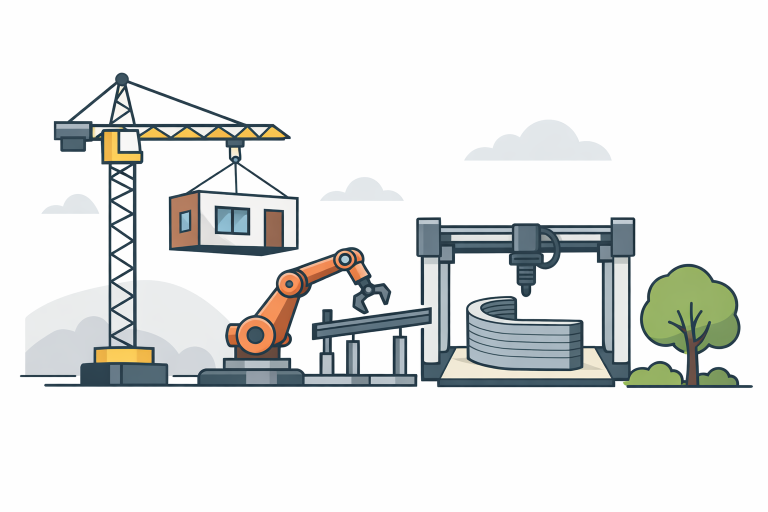
In the ever-changing landscape of architecture and construction, new technologies and modern methods are redefining how we plan, design, and build. These advancements are helping the industry achieve enhanced efficiency and greater sustainability while meeting increasing demands for resilience and adaptability. Progressive building companies, such as Tutor Perini, are leading examples of how innovation can be integrated into complex projects, setting new standards for the built environment.
Industry leaders and academic researchers continue to explore the boundaries of what is possible through automation, advanced materials, and digital tools. These transformative approaches are not only improving timelines and cost-efficiency but are also reducing environmental impacts, delivering healthier spaces for occupants, and creating structures designed to thrive for generations.
Robotic Assembly in Construction
The use of robotic systems in construction is increasing as firms seek to improve on-site quality, precision, and productivity. Robots can assemble prefabricated components more quickly and accurately than human labor, reducing the risk of human error. For example, researchers at MIT have developed autonomous robots that assemble modular building blocks, pointing toward a future where teams of robots handle repetitive and complex assembly tasks. This enables projects to maintain tight deadlines and minimize waste. These robotic systems are also being credited with making sites safer, as automation can handle dangerous or physically demanding jobs that have traditionally put construction workers at risk.
3D Printing for Structural Elements
Structural 3D printing is quickly transforming modern construction by introducing new possibilities for designing and building walls, support systems, and entire buildings. Using precise layer-by-layer material placement, this technology offers remarkable design freedom while reducing labor demands, construction timelines, and material waste. Its ability to create complex structural components with consistent accuracy makes it increasingly attractive for both residential and commercial projects. Japan’s first government-approved two-story 3D-printed home, engineered for earthquake resistance, highlights how automated construction can produce safe, durable, cost-effective buildings capable of withstanding challenging environmental conditions.
Mass Timber Construction
Mass timber, particularly cross-laminated timber (CLT), has emerged as a sustainable alternative to concrete and steel. Projects in the United States, such as a five-story building in Boston’s Roxbury area, demonstrate how CLT can achieve net-zero energy performance while reducing carbon footprints. These buildings not only sequester carbon but also reduce overall energy use for heating and cooling thanks to wood’s natural insulating properties. The adoption of mass timber is accelerating, as it enables faster construction and aligns with the growing push for sustainable development in urban and suburban areas.
Modular and Prefabricated Building
Speed, efficiency, and lower environmental impacts are the hallmarks of modular and prefabricated construction methods. By manufacturing building sections off-site and assembling them on location, these approaches dramatically reduce waste and construction timelines. They are especially effective for large-scale projects like student housing, where time constraints and budget considerations are paramount. Prefabricated solutions are enabling schools, hospitals, and residential buildings to open quickly, keeping pace with demand while slashing on-site disruption.
Sustainable Materials and Methods
The push toward greener buildings is inspiring the invention and adoption of advanced materials. From self-healing concrete, which can repair its own minor cracks and extend a structure’s lifespan, to aerogels and advanced insulation, these new materials play a vital role in making construction more sustainable. Self-healing concrete, for instance, uses bacteria or chemical additives that react with air and moisture to create calcium carbonate, which repairs damage naturally. These innovations are already influencing the durability and longevity of structures in climates around the world.
Digital Tools and BIM Integration
Building Information Modeling (BIM), especially when integrated with augmented and virtual reality, is transforming project coordination. By providing a comprehensive digital representation of buildings’ physical and functional characteristics, BIM enables improved stakeholder collaboration, greater transparency, and smoother workflows. When integrated with AR and VR, project teams can walk through a building long before construction is complete, troubleshoot issues in real time, and communicate precise details visually to clients, builders, and facility managers. This digital transformation is driving better decision-making and optimizing project outcomes.
Collaborative Robotic Fabrication
Collaborative robotics, commonly known as cobots, is transforming modern construction by enabling teams of robots to perform highly precise assembly tasks on intricate or large-scale building projects. Unlike traditional machinery, cobots can work alongside human operators or in coordinated robotic groups to construct complex structural forms with exceptional accuracy. In research environments and pilot applications, these systems have successfully assembled challenging geometries, including masonry arches and free-form structures, often without scaffolding. This innovation expands architectural possibilities, improves efficiency, reduces labor constraints, and opens the door to previously impractical design solutions.
Conclusion
Architecture and construction are undergoing remarkable changes, driven by the integration of robotics, advanced materials, modular techniques, and digital tools. These innovations not only address the need for smarter, more resilient structures but also ensure that future buildings are environmentally responsible and cost-effective to deliver. As companies continue to push the boundaries, the industry can look forward to a future where our built environment is safer, more efficient, and more sustainable than ever before.


