
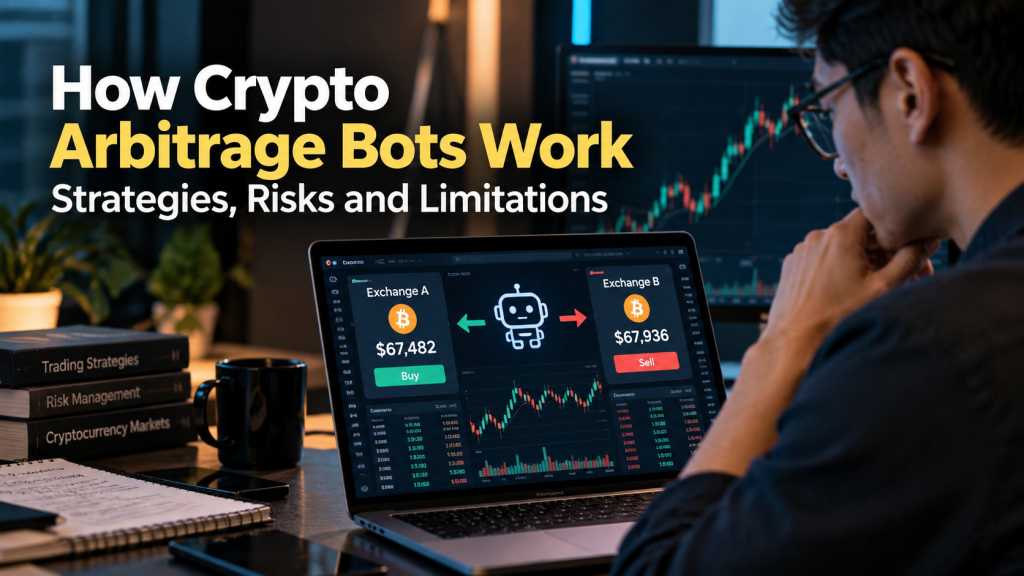
A crypto arbitrage bot compares prices across exchanges or related markets and trades when a discrepancy appears large enough to cover execution costs. Automation improves speed, but latency, liquidity and failed orders mean arbitrage is not risk-free.
Key Takeaways
- Bots automate market monitoring, calculations and execution.
- Common strategies include cross-exchange, triangular, spot-futures and on-chain arbitrage.
- Profit depends on the net spread after fees, slippage, price impact, funding, gas and other costs.
- Liquidity and execution speed matter as much as the price gap.
- Competition causes many opportunities to disappear quickly.
Crypto Arbitrage Strategies Compared
| Strategy | Where It Happens | Basic Approach | Main Constraint | Key Risk |
| Cross-exchange arbitrage | Two or more exchanges | Buy lower, sell higher elsewhere | Capital on both venues | Prices move before both orders fill |
| Triangular arbitrage | Usually one exchange | Trade through three related pairs | Small, short-lived gaps | Fees and partial execution |
| Spot-futures / funding arbitrage | Spot + derivatives | Capture basis or funding | Margin access | Funding, basis, liquidation |
| DEX arbitrage | Liquidity pools / DEXs | Exploit price differences | Gas and MEV competition | Price impact and reverts |
What Is a Crypto Arbitrage Bot?
Arbitrage targets temporary pricing differences between related markets. A bot automates that process:
- Receive real-time price and order-book data.
- Compare executable prices, not just last-traded prices.
- Estimate transaction costs.
- Check whether the spread exceeds a minimum threshold.
- Submit the required orders.
- Confirm fills and rebalance if necessary.
The bot does not create the opportunity. It improves monitoring and execution.
How Do Crypto Arbitrage Bots Find Profitable Opportunities?
Price Feeds and Order-Book Monitoring
Bots usually connect to APIs or WebSocket feeds for bids, asks and market depth. A realistic calculation uses the best ask when buying, the best bid when selling and enough depth for the intended size.
For example, a trader monitoring the AAST token price might use the displayed price as a reference, but a bot still needs to compare executable bids, asks and depth across relevant venues before treating a difference as a real opportunity.
Calculating the Net Arbitrage Spread
Potential net edge = gross price discrepancy + expected funding received − trading fees − slippage or price impact − gas/network costs − borrowing costs − funding paid − other execution and rebalancing costs.
Funding is a signed cash flow, so it can help or hurt returns.
If an asset can be bought for $100.00 on Exchange A and sold for $100.40 on Exchange B, the gross spread is 0.40%. If fees and execution effects total 0.35%, only about 0.05% remains before further price movement or execution error.
Four Common Crypto Arbitrage Bot Strategies
1. Cross-Exchange Arbitrage
The bot buys where an asset is cheaper and sells where it is more expensive.
Because gaps close quickly and deposit or withdrawal times can be unpredictable, traders often pre-position inventory on both venues rather than transfer assets after a signal appears.
That improves speed but fragments capital and adds venue risk.
2. Triangular Arbitrage
Triangular arbitrage exploits inconsistent prices across three trading pairs on one exchange: USDT → BTC → ETH → USDT
If the relative rates fall out of line, the cycle may return more USDT than it started with. The opportunity must exceed cumulative trading costs across all three legs, and partial fills can erase the edge.
3. Spot-Futures and Funding Arbitrage
A common setup combines a long spot position with a similar-sized short perpetual. The trader may target funding income, a narrowing basis or both while reducing directional exposure.
A long-spot, short-perpetual position may receive funding when the funding rate is positive, but it pays funding when the rate turns negative.
Perpetuals have no expiry date that mechanically forces convergence, unlike dated futures with a defined settlement point.
Changing funding, basis risk and liquidation can still affect the trade.
4. DEX and On-Chain Arbitrage
On-chain bots compare prices across AMM pools or between decentralized and centralized venues. Uniswap describes arbitrage as one mechanism that helps bring pool prices back toward wider market prices.
Included transactions can consume gas even if execution reverts. Off-chain simulations or opportunities never submitted or included do not necessarily incur an on-chain fee.
DEX arbitrageurs may also compete with specialized MEV searchers.
Explore: 5 Reasons Why You Shouldn’t Be Afraid of Investing in Crypto
What Can Go Wrong With a Crypto Arbitrage Bot?
Slippage and Insufficient Liquidity
A visible spread can disappear at meaningful size as orders consume order-book depth or move an AMM pool.
Price impact and slippage are related but distinct. Price impact comes from the trade itself, while slippage is the difference between expected and actual execution price. Uniswap distinguishes the two.
Execution and Leg Risk
One side may fill while the other does not, leaving a supposedly market-neutral trade temporarily exposed to price direction.
Latency
Market data can become stale before order submission. Another bot may take the available liquidity first.
Fees
Costs can include trading fees, network fees, gas, borrowing, margin interest, funding paid, conversion and rebalancing expenses. Funding received belongs on the positive side of the calculation.
API and Infrastructure Failures
Bots depend on reliable connectivity. Kraken documents separate API rate-limit categories, while Binance applies request-weight and order-count controls. Outages or rejected orders can leave a position incomplete.
Why Crypto Arbitrage Bots Have Important Limitations
Some constraints are structural:
- Competition: profitable gaps attract automated traders and close quickly.
- Small margins: liquid markets often leave thin spreads after costs.
- Capital fragmentation: cross-exchange strategies tie up funds across venues.
- Limited scalability: larger trades create more price impact.
- Operational complexity: data, monitoring and error handling require maintenance.
- Venue exposure: capital on exchanges remains exposed to operational and counterparty risk.
- On-chain competition: DEX strategies may compete with specialized MEV infrastructure.
How to Evaluate an Arbitrage Opportunity Before Automating It
- Is the spread real? Compare executable bid and ask prices.
- Does it survive all costs? Include fees, slippage, price impact, funding, borrowing, gas and rebalancing.
- Is there enough liquidity? Check depth at the intended size.
- Can both legs execute reliably? Consider latency, API limits and partial fills.
- What happens if the trade fails halfway? Define exposure limits and exit logic.
Test the economics before optimizing bot speed.
Crypto Arbitrage Bots Are Automation Tools, Not Profit Machines
Arbitrage bots react faster than manual execution, but fees, competition and execution risk remain. What matters is the spread left after every trade is filled and all relevant costs are included.
FAQs
Are crypto arbitrage bots profitable?
They can be, but results depend on fees, liquidity, competition and execution quality. Many visible gaps disappear before they can be captured.
Is crypto arbitrage risk-free?
No. Risks include slippage, failed execution, venue exposure, changing funding, margin risk and infrastructure failures.
How much price difference does an arbitrage bot need?
There is no universal percentage. The spread must exceed all expected costs and leave room for price movement or partial fills.
Do arbitrage bots need funds on multiple exchanges?
Often, yes, for cross-exchange strategies. Pre-positioning funds improves speed but fragments capital and increases venue exposure.
What Is the Difference Between Arbitrage Bots and Grid Trading Bots?
Arbitrage bots target price discrepancies between related markets. Grid bots place repeated orders at predefined price levels and rely more on movement within a range.