
Ultimate Checklist for HVAC PPC Campaigns
At its core, pay-per-click (PPC) advertising is a model where you pay a fee each time one of your ads is clicked. For HVAC businesses, this is essentially buying visits to your site rather than attempting to “earn” those visits organically through long-term SEO efforts. When a potential customer types “emergency AC repair near me” into Google, the search engine holds an instantaneous auction. Your ad’s ability to appear at the top of the results page depends on a combination of your bid and the relevance of your ad.
Unlike traditional advertising—such as mailers or radio spots—PPC is hyper-targeted. You aren’t broadcasting to a general audience; you are reaching people who have already identified a problem and are actively searching for a solution. This high-intent traffic is the lifeblood of successful HVAC lead generation.
Evaluating the Core Benefits and Drawbacks of PPC
The primary advantage of PPC is speed. While search engine optimization is a powerful, necessary long-term play, it can take months to see significant movement in organic rankings. PPC, by contrast, can put your business in front of local homeowners within hours of launching a campaign. This makes it an ideal tool for managing seasonal demand, such as ramping up your budget during the first week of a summer heatwave.
However, the model is not without its challenges. The most significant drawback is the cost of entry. In competitive metropolitan areas, keywords like “HVAC installation” can command high prices per click. If your campaigns are not structured correctly, you can burn through your budget quickly without seeing a return. Furthermore, PPC requires constant monitoring. If you set your ads to “autopilot,” you may encounter ad fatigue, where your messaging becomes stale and stops generating the same volume of clicks, or worse, you may attract “junk” traffic from users searching for DIY tips or job listings.
How Google Ad Rank and Quality Score Impact Ad Costs
Many contractors assume the highest bidder always wins the top spot on Google. In reality, Google uses a metric called “Ad Rank” to determine placement. Ad Rank is calculated by multiplying your maximum bid by your Quality Score.
Quality Score is a diagnostic tool that measures the relevance of your ad, your expected click-through rate, and your landing page experience. If your ad for “furnace repair” leads to a generic homepage that doesn’t mention furnaces, your Quality Score will plummet. A low score forces you to pay more per click to maintain your position. Conversely, if you have a highly relevant ad that leads to a dedicated, fast-loading page, Google rewards you with a lower cost per click and a better ad position. This is why focusing on landing page quality is just as important as the money you spend on the bid itself.
Strategic Setup: Campaign Structure, Targeting, and Ad Types
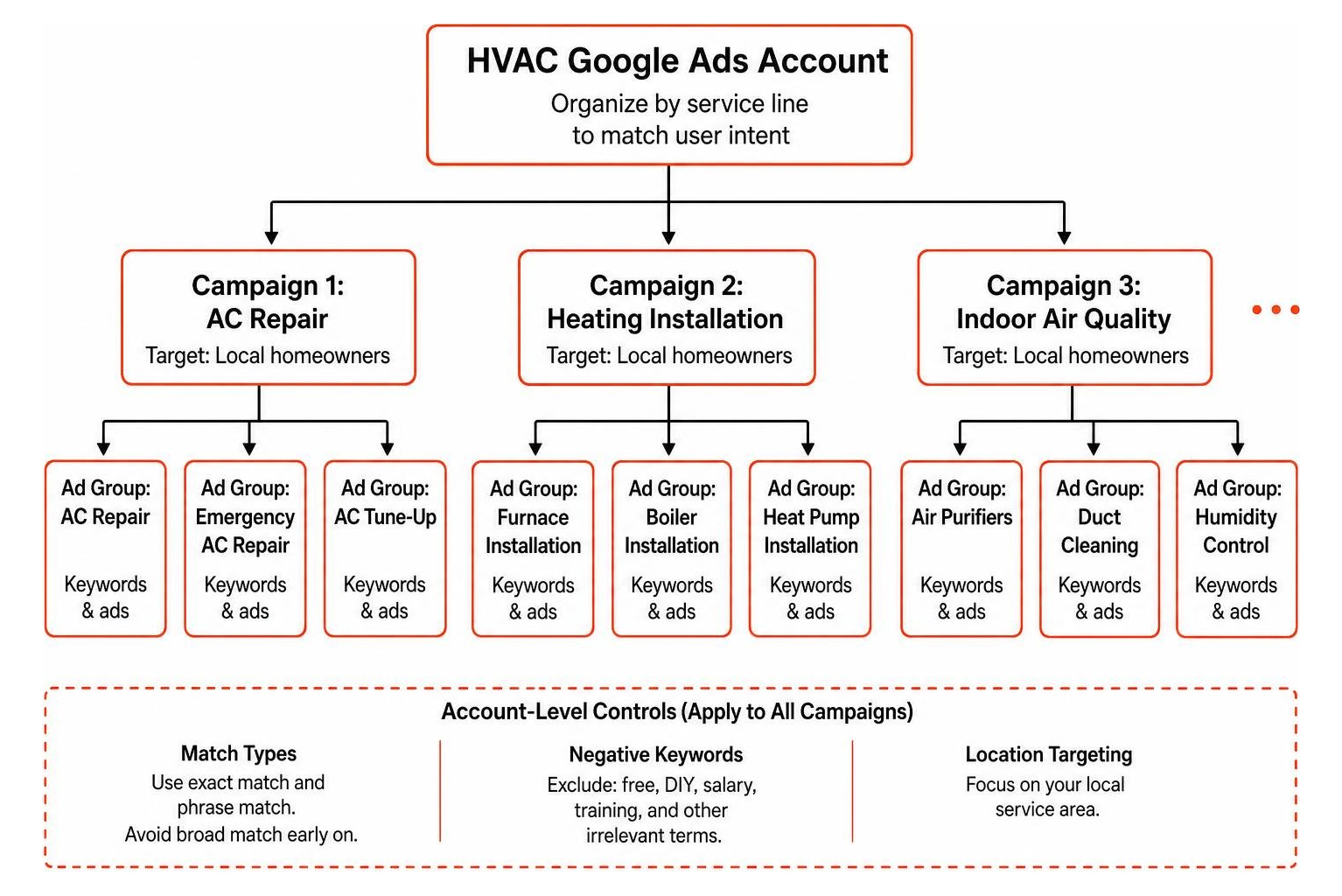
A disorganized account is the fastest way to waste money. We recommend segmenting your campaigns by service line—such as AC repair, heating installation, and indoor air quality—rather than running everything under one umbrella. This allows you to write specific ad copy that speaks directly to the user’s intent.
When selecting keywords, match types are your best friend. “Exact match” ensures your ad only shows for the specific term you’ve chosen, while “phrase match” allows for some variations. Avoid “broad match” in the early stages, as it can trigger your ads for irrelevant searches that drain your budget. Equally important is your negative keyword list—a collection of terms like “free,” “DIY,” “salary,” or “training” that you instruct Google to ignore to prevent wasted spend.
Comparing Search Ads, LSAs, Display, and Paid Social for HVAC PPC Campaigns
Not all ads are created equal. Understanding the role of each platform is key to a balanced strategy:
Ad Type Primary Intent Billing Model Best For Search Ads High (Active Search) Per Click Immediate repair/install leads Local Services Ads (LSAs) Very High (Immediate) Per Lead Emergency calls, trust-building Display Ads Low/Medium (Awareness) Per Click/Impression Remarketing to past visitors Paid Social Low (Interest) Per Click/Impression Seasonal promotions/brand awareness Local Services Ads (LSAs) are particularly powerful for HVAC contractors because they feature the “Google Guaranteed” badge, which builds instant trust. Unlike traditional search ads, you generally pay per lead (a phone call or message) rather than per click, which can be highly efficient for emergency service providers.
Commercial vs Residential Targeting Nuances
Residential HVAC PPC often focuses on the homeowner’s immediate comfort, with ads scheduled during daytime hours when they are likely to notice a system failure. Commercial HVAC, however, is a different beast. Commercial projects often involve facility managers or business owners with longer decision-making cycles. Targeting for these leads should include more technical keywords and, in many cases, 24/7 ad scheduling to capture the needs of businesses that cannot afford downtime. The average order value for commercial contracts is typically higher, justifying a more aggressive bidding strategy for those specific terms.
Execution and Optimization: Driving High-Intent Conversions
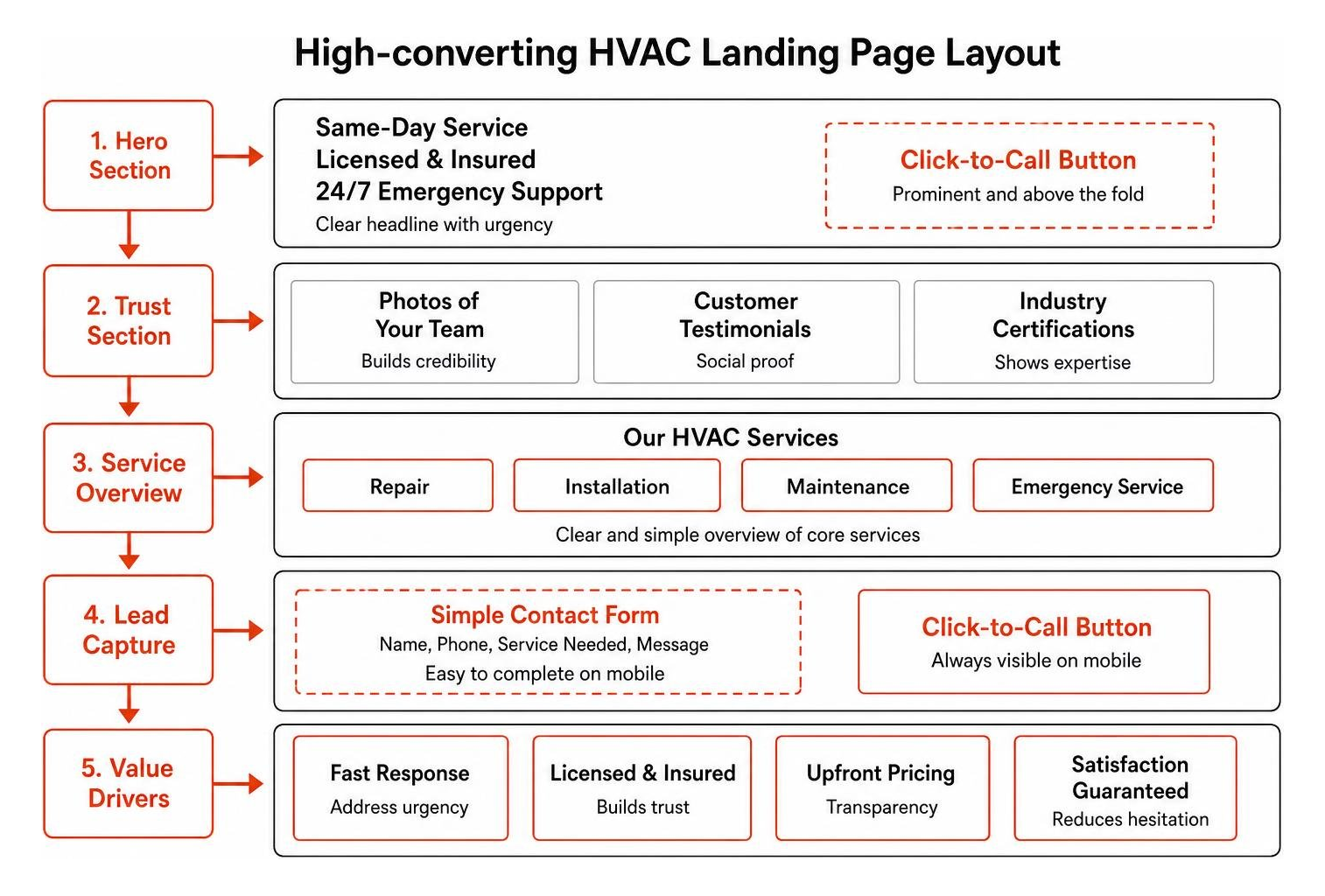
Once you have the traffic, you must ensure it converts. Mobile optimization is non-negotiable. Most emergency HVAC searches happen on smartphones while the user is standing in a hot house or a cold office. Your landing page must feature a prominent “Click-to-Call” button and a clear, simple form.
When running HVAC PPC campaigns, your ad copy should reflect the urgency of the situation. Use phrases like “Same-Day Service,” “Licensed & Insured,” and “24/7 Emergency Support” to capture attention. During peak seasons, you should adjust your bids upward to ensure you don’t lose visibility when demand is at its highest.
Execution Checklist: Best Practices to Optimize HVAC PPC Campaigns
To keep your campaigns performing at their peak, follow this checklist:
- Dedicated Landing Pages: Never send PPC traffic to your homepage. Create a specific page for each service that mirrors the ad copy.
- Trust Signals: Include photos of your team, customer testimonials, and industry certifications above the fold on your landing pages.
- A/B Testing: Regularly test different headlines, calls-to-action, and images to see what drives the highest conversion rate.
- Speed Optimization: Ensure your landing pages load in under three seconds; slow pages lead to high bounce rates.
Multi-Channel Integration: Unifying PPC, Local SEO, and Social Media
PPC should never exist in a vacuum. It works best when it supports your broader digital ecosystem. For example, use your PPC data to inform your SEO strategy; if a specific keyword is converting well in ads, that’s a clear signal you should create organic content around it. Additionally, use remarketing display ads to stay in front of people who visited your site via an ad but didn’t book a service. By keeping your brand top-of-mind across multiple channels, you increase the likelihood that they will call you when they are finally ready to pull the trigger.
Measuring Success: Key Performance Indicators, Benchmarks, and Costs
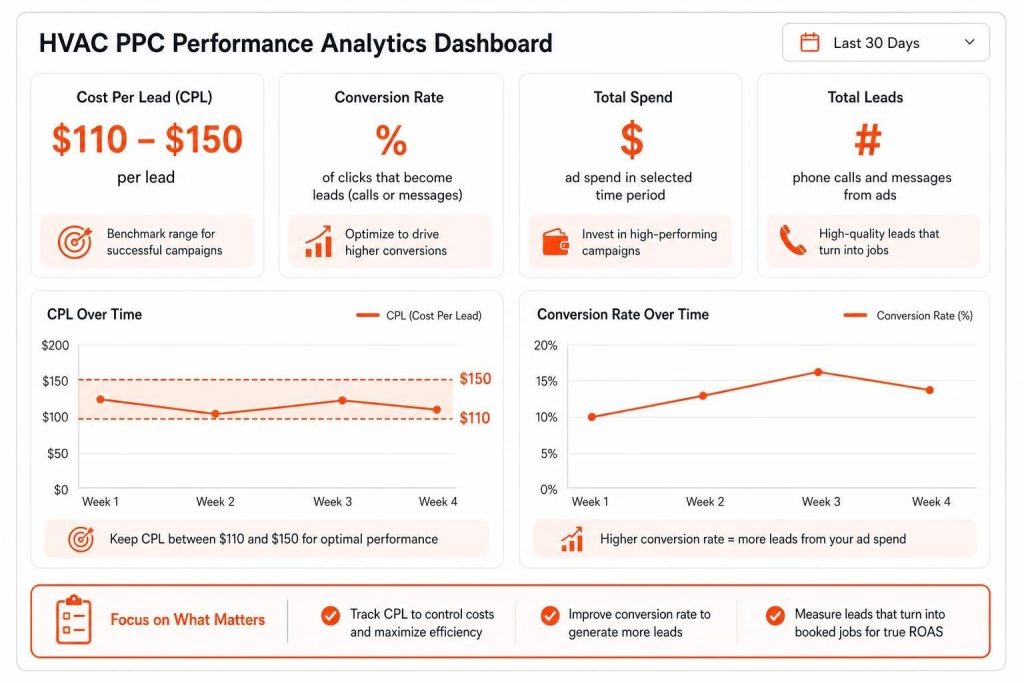
You cannot improve what you do not measure. The most critical metric for any HVAC business is the Cost Per Lead (CPL). While benchmarks fluctuate based on your market, most successful campaigns settle between $110 and $150 per lead. If your CPL is significantly higher, you likely have an issue with keyword relevance or landing page conversion.
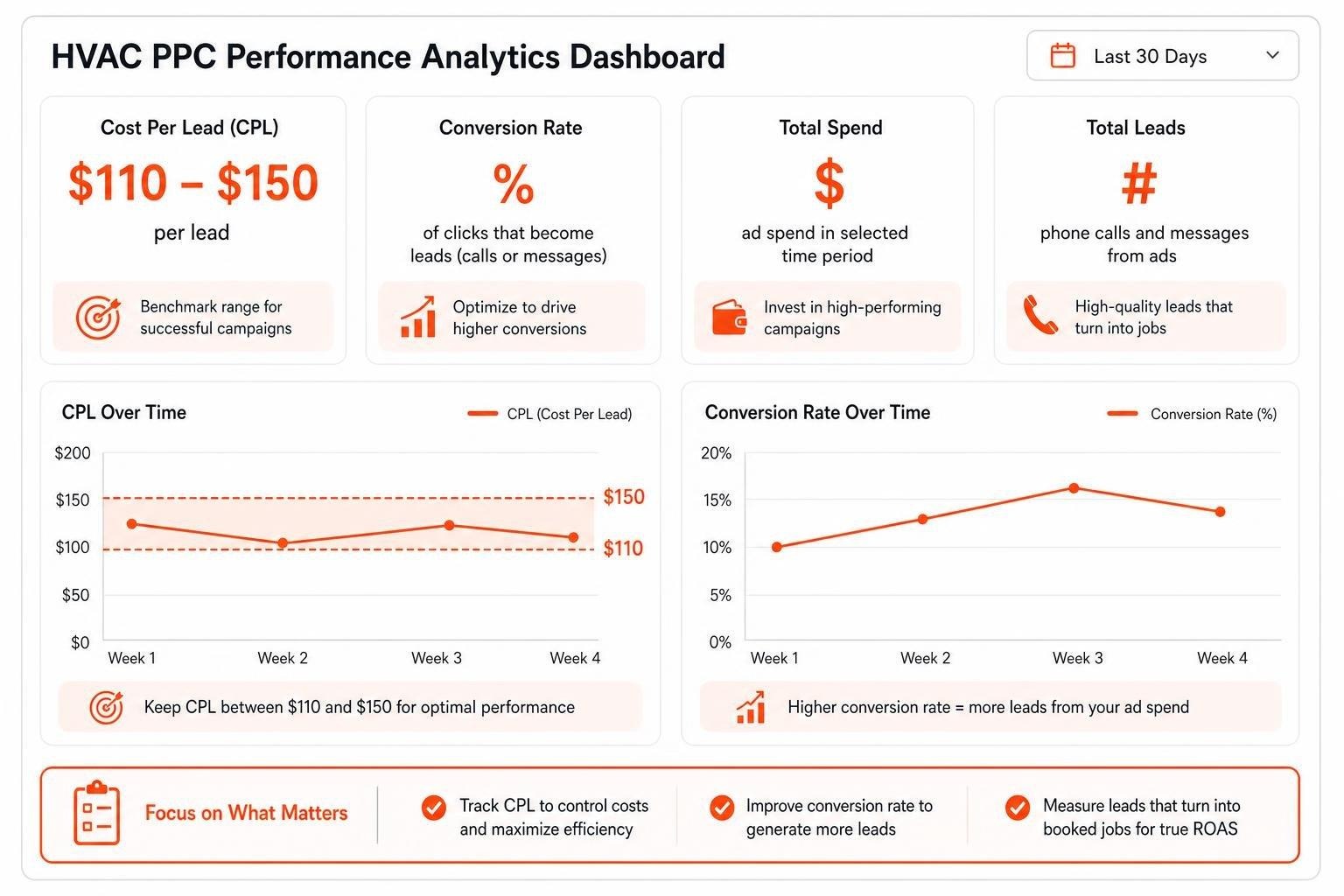
Integrate your PPC campaigns with your CRM or call-tracking software so you can see exactly which ads are leading to booked jobs—not just phone calls. This allows you to calculate your true Return on Advertising Spend (ROAS). If a campaign is generating calls but those calls aren’t turning into jobs, you may need to adjust your targeting to filter out lower-quality leads.
Frequently Asked Questions About HVAC PPC
How much should an HVAC company budget monthly for PPC ads?
There is no “one size fits all” number. A good rule of thumb is to start with a budget that allows for at least 50 to 100 clicks per month in your target area. This provides enough data for Google’s machine learning to optimize your campaign. As you see results, you can scale your budget based on your capacity to handle new jobs.
What is a realistic cost per lead for residential HVAC PPC?
In most markets, a healthy CPL for residential services ranges from $110 to $150. However, highly competitive metros may see costs climb higher. The goal is to balance this cost against your average ticket size. If you are paying $150 for a lead that turns into a $5,000 installation, the ROI is excellent.
Why should HVAC ads avoid directing traffic to the website homepage?
The homepage is designed for general brand information, not for converting a specific need. When a user clicks an ad for “AC repair,” they want to see information about AC repair immediately. If they land on a homepage and have to hunt for the service they need, they will likely hit the “back” button and click on a competitor’s ad instead.
Conclusion
Mastering HVAC PPC campaigns is a discipline of constant refinement. It requires a blend of technical account management, creative ad copywriting, and a deep understanding of your local market. By focusing on high-intent keywords, building dedicated landing pages, and obsessively tracking your cost per booked job, you can turn your digital advertising into a predictable, scalable engine for growth. The goal isn’t just to get clicks—it’s to be the first business a homeowner trusts when their comfort is on the line. With a disciplined, data-driven approach, you can ensure your business remains the go-to provider in your community, season after season.


